Your sugar goes up after a meal. Tirzepatide helps your body release insulin, which lets cells take sugar from your blood.
Hunger can ease as well as sugar. Learn why the drug stays in your blood, and what cells and mice can tell researchers.
After meals, hormone actions help your body release insulin
After eating, you can feel full while your sugar rises. Hormones from your gut prompt insulin release from your pancreas.
Insulin lets cells use sugar circulating in your blood. Meal hormones called GIP and GLP-1 help start that response.
Scientists based tirzepatide on GIP, then added GLP-1's action to the design. Your body makes those hormones, but doesn't naturally make tirzepatide.
The medicine uses both actions without supplying two separate natural hormones. Earlier drugs used just the meal hormone GLP-1's action.
The weight and sugar improvements in studies were larger with tirzepatide. The way a drug works is called its mechanism of action.
Knowing the action won't predict your weight loss. Studies treating people give your doctor firmer evidence than cell tests.
Scientists added fat to help blood protein carry the drug
You still have about half the medicine in your body after 5 days [1]. That slow clearing supported weekly treatment with shots.
The medicine contains 39 amino acids (parts joined to form a protein). Scientists changed a design based on GIP, a meal hormone.
The changes let tirzepatide also copy the meal hormone GLP-1 [1]. Your body doesn't make this changed medicine.
At position 20 along the chain, scientists attached a small fat part. That fat part isn't taken from your stored body fat.
A blood protein called albumin can carry the drug because of that addition. Albumin holds the drug, then lets go again.
Think of albumin as a bus carrying the medicine through your blood. Your body doesn't clear the drug as quickly while albumin holds it.
This long stay helps explain why the drug lasts between shots. The clearing time isn't a reason to alter your own prescription.
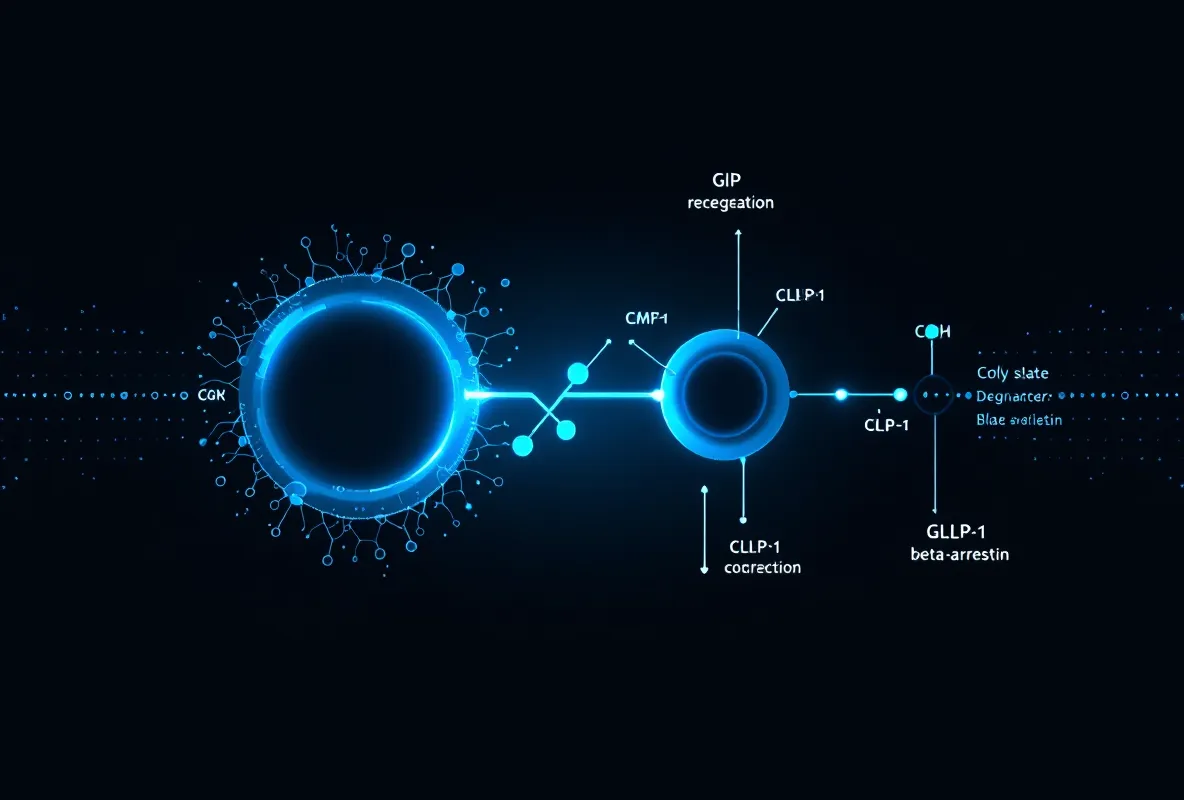
Cells kept more hormone attachment places open on the surface
In 2020, Willard's team grew cells in dishes for testing [2]. They checked tirzepatide's actions at the meal hormones' attachment places.
Hormones attach to proteins on the outside of cells. Attachment starts a chemical response inside the cell that prompts insulin release.
Tirzepatide strengthened that response more through GIP than GLP-1. This cell result didn't measure hunger or blood sugar in people.
The chemical passes the insulin-release instruction into the cell. Your body's overall benefit can't be read from that response alone.
Cells can also pull their hormone attachment proteins inward. Once inside, those proteins can't receive hormones from outside the cell.
Tirzepatide left more of these proteins outside than natural GLP-1 did. Leaving the attachment places available could prolong insulin release.
The study didn't establish how long that would last in you. That differs from the drug's long stay in your blood.
Researchers also tested insulin-making pancreas cells taken from mice. They examined a protein that acts as a brake on insulin release.
That brake reduced insulin release prompted by natural GLP-1. The same brake didn't reduce insulin release with GIP or tirzepatide [2].
A 2024 study tested slightly different versions of GIP's attachment protein [10]. These versions differ in a small part of their protein chain.
With either version, tirzepatide strongly increased the chemical that prompts insulin release. Other chemical responses inside the cells were weaker.
So the drug didn't strengthen every cell response equally. The weaker responses weren't shown to mean a benefit or harm for people.
Zhao's team took detailed images of drug attachment in 2022 [8]. The images showed attachment at both hormones' usual places, in different ways.
Mice and human cells used the hormone actions differently
After a meal raises sugar, GIP prompts insulin release from your pancreas [9]. GIP is a meal hormone that also affects eating, bone and fat.
Scientists tested obese mice without working attachment proteins for GLP-1. GLP-1 is another meal hormone, whose action affects insulin and hunger.
Tirzepatide still helped the mice use insulin more effectively. Their white fat, which stores energy, took more sugar from blood.
That improvement didn't require the mice to lose weight. A separate medicine copying GIP produced the same change.
Both medicines lowered certain amino acids in the mice's blood. Amino acids join together when your body forms proteins.
The fall suggested a change in how the mice used those parts. It didn't establish that the mice lacked protein or lost strength.
Their brown fat, which produces heat, showed changes too. The cells used their instructions for processing sugar, fat and protein parts more actively.
That suggests changed fuel use, but doesn't measure how much fat burned. The mouse finding can't establish fat-burning benefits for you.
The other meal hormone helps insulin release and slows stomach emptying [9]. Food entering the gut more slowly can limit a sharp sugar rise.
That hormone also curbs glucagon, which pushes sugar upward, and eases hunger. Your whole body and health affect your response.
Both hormones have attachment proteins in several organs, including kidneys and heart [9]. Those proteins let the drug act beyond insulin-making cells.
Scientists then blocked GIP's action in human pancreas cells outside the body. The cells released less insulin with tirzepatide after the block [11].
Blocking GIP had little effect on mouse pancreas cells [11]. The mice relied more on the other meal hormone's action.
Tirzepatide acts less strongly through the mouse version of GIP's attachment protein. That helps explain why mouse findings can't settle your response.
Tirzepatide improved adult results beyond meal hormone GLP-1 alone
Adults lost more weight with tirzepatide in a direct treatment comparison. Semaglutide, the other medicine, also treats diabetes and excess weight.
SURMOUNT-5 studied 751 adults with obesity for 72 weeks [5]. Average loss was 20.2% of starting weight with tirzepatide, versus 13.7% with semaglutide.
Your own loss isn't settled by those averages. Your illnesses and side effects also matter when your doctor weighs treatment.
SURPASS-2 followed 1879 adults who had type 2 diabetes. This phase 3 study compared benefits and harms of the medicines.
Weekly tirzepatide amounts were 5 mg, 10 mg and 15 mg. Each brought bigger weight and sugar improvements than semaglutide at 1 mg [3].
Semaglutide uses the meal hormone GLP-1's action to help insulin and hunger. Tirzepatide uses that action plus the other meal hormone, GIP.
Earlier, in 2018, researchers had compared the actions in mice [1]. Tirzepatide reduced eating and weight further in mice than GLP-1 action alone.
Those mouse findings are separate from the adult results above. Scientists suggest two possible reasons for the difference between medicines.
Reason (1) is that GIP adds its own insulin-release and weight effects. The added action helps beyond what the other meal hormone does.
Reason (2) comes from tests of insulin-making cells [2]. Tirzepatide left more hormone attachment proteins outside the cells, ready to respond.
That could prolong insulin release, but researchers don't know the duration. A review examined medicines combining both meal-hormone actions [37].
Neither proposed reason promises an extra benefit for your own health. Studies treating people matter most when you discuss the choice.
Detailed images showed the 39-amino-acid chain attaching at both hormones' usual places [8]. Amino acids join together to form a protein.
Cell tests helped explain differences between those hormone actions [2]. Tirzepatide research describes what changed in people receiving treatment.